


R1820 V1.0 – Technical Product Description
5K LCD Monitor Control Board for iMac 27" Panels
Overview
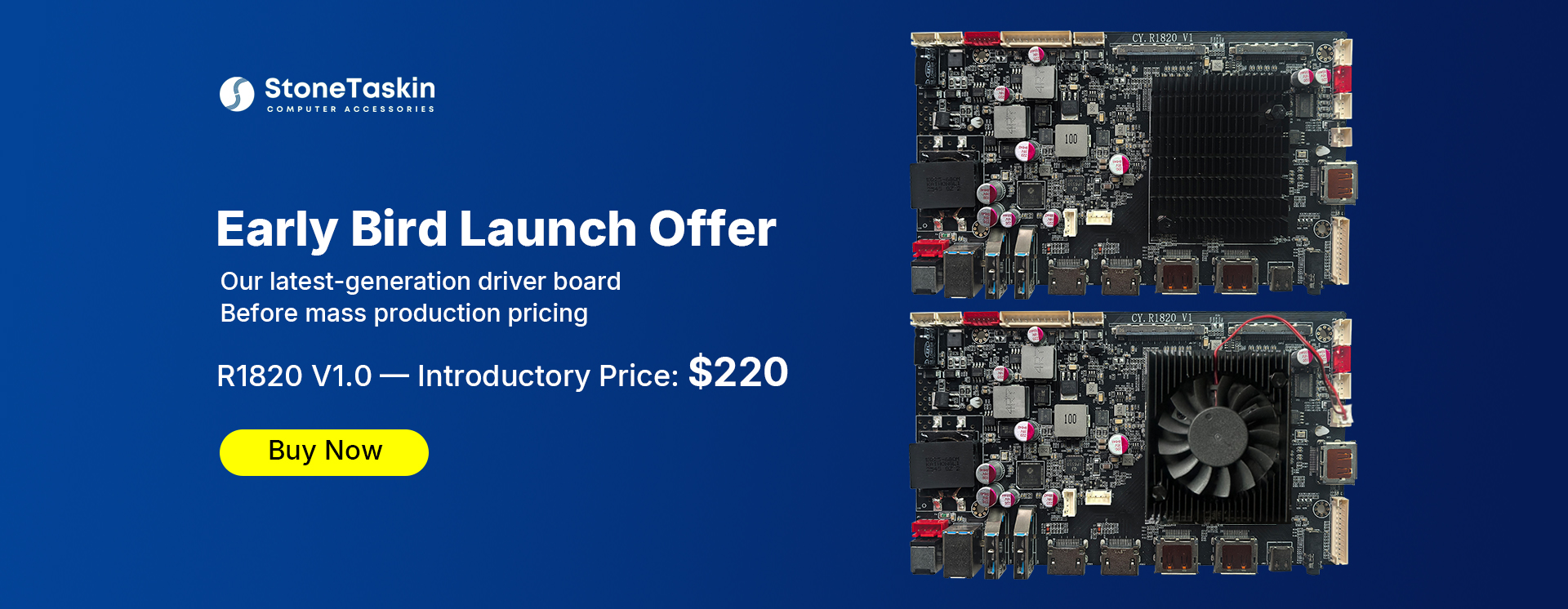
R1820 V1.0 is a high-performance LCD monitor control board designed to drive QQHD (5120×2880) TFT LCD panels.
It is specifically engineered for iMac 27-inch LCD panels LM270QQ1 and LM270QQ2 (all suffix versions) and supports modern high-bandwidth video interfaces, flexible power configurations, and advanced display control features.
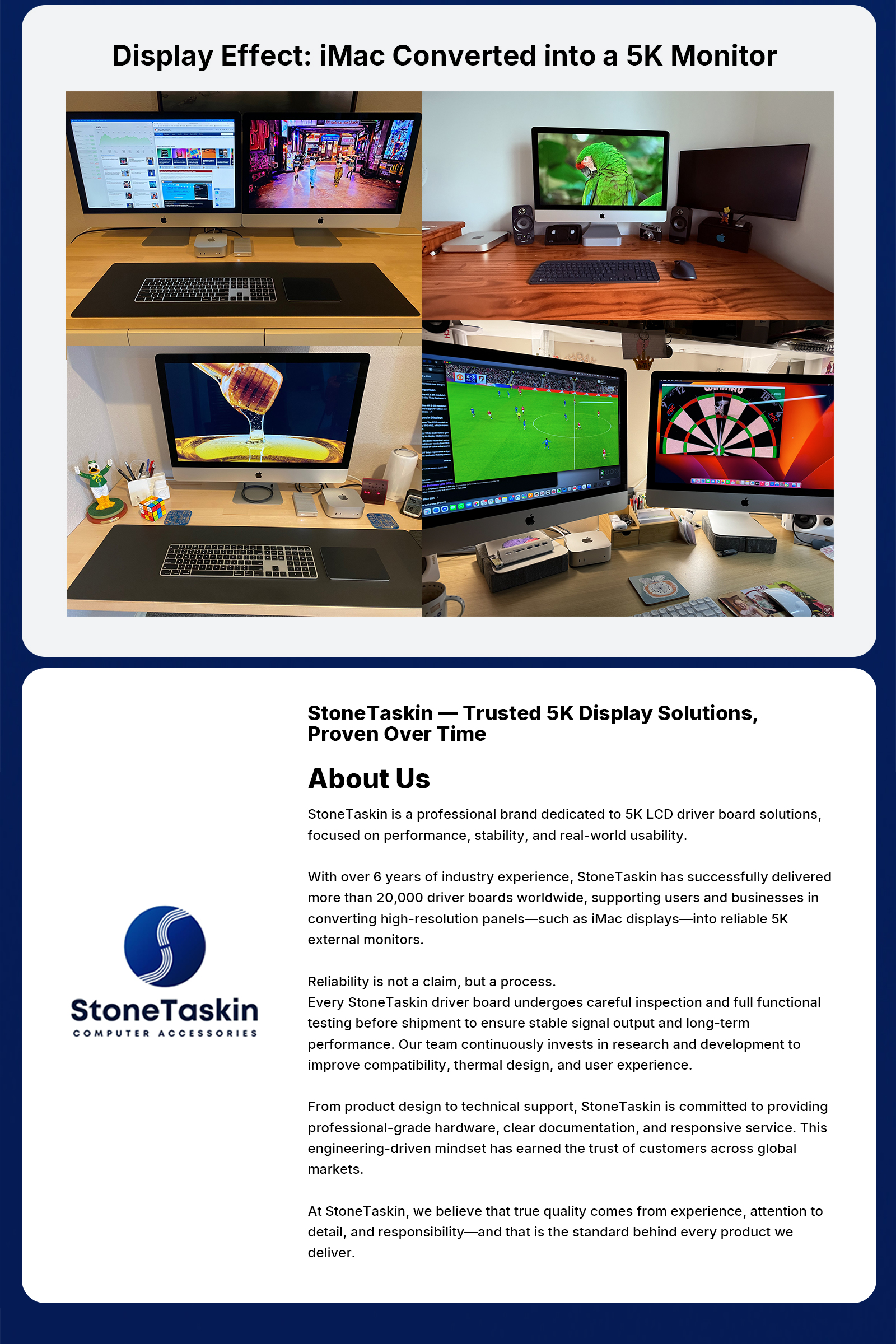
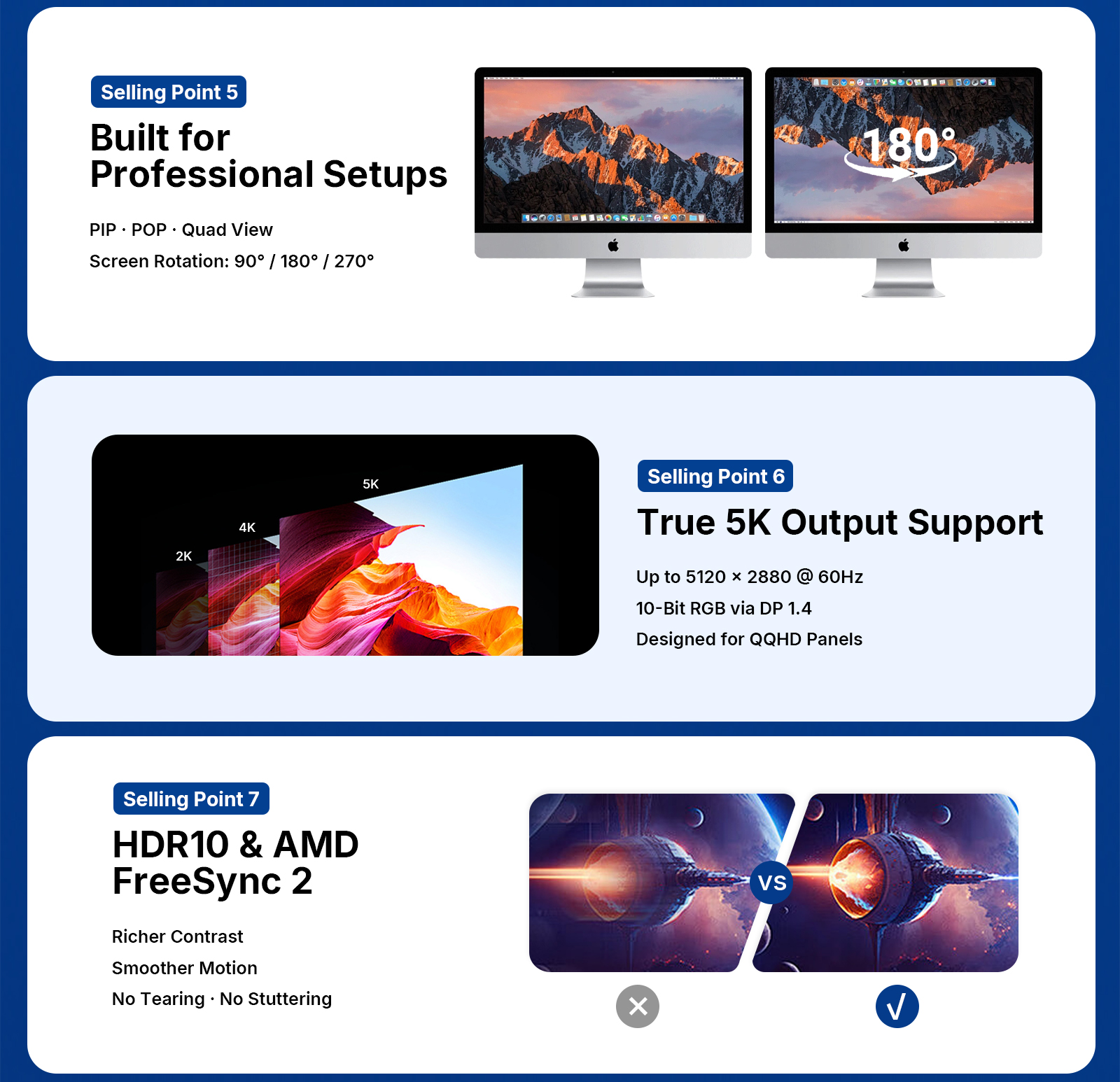
The board is suitable for professional display systems, iMac panel reuse projects, engineering applications, and high-resolution external monitor designs.
Supported LCD Panels
-
LG LM270QQ1 (All suffix versions)
-
LG LM270QQ2 (All suffix versions)
Panel interface support:
-
V-by-One HS
-
eDP HRB / eDP HRB2
Display Performance
-
Maximum resolution: 5120 × 2880 (QQHD / 5K)
-
DisplayPort output:
-
5K @ 60Hz, RGB 10-bit
-
4K @ 144Hz
-
-
HDMI output:
-
4K @ 120Hz (HDMI 2.1 hardware decoding)
-
-
HDR support:
-
HDR10
-
-
Adaptive sync:
-
AMD FreeSync 2
-
Designed for high pixel density panels with stable long-term signal output.
Video & Signal Interfaces
-
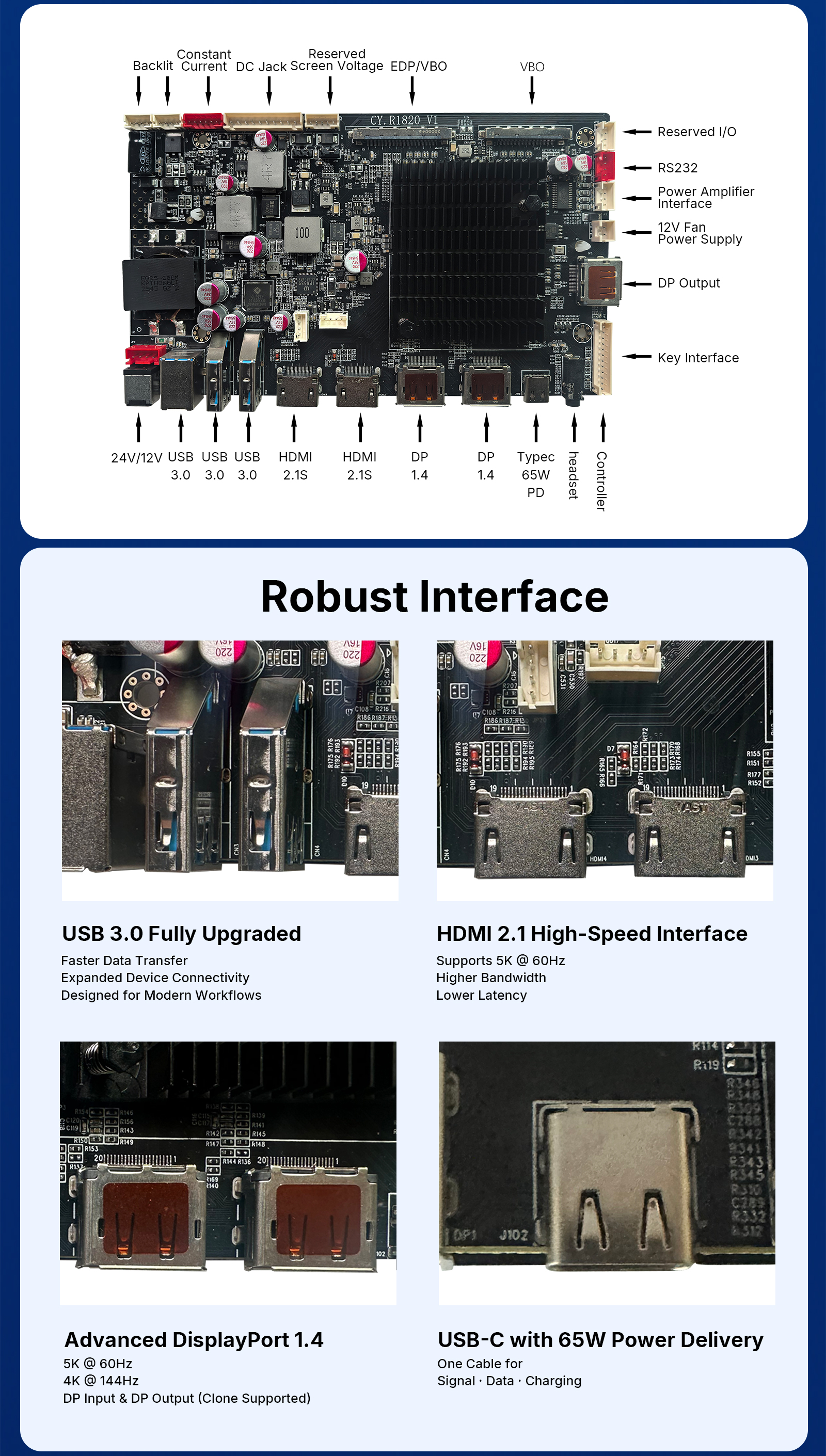
HDMI ×2
-
HDMI 2.1 protocol
-
High-bandwidth, low-latency transmission
-
-
DisplayPort
-
DP IN ×2
-
DP OUT ×1 (clone supported)
-
Supports DP 1.1 / 1.2 / 1.4
-
-
USB Type-C ×1
-
Display signal input
-
USB data
-
Power Delivery up to 65W
-
-
Audio Output
-
3.5 mm headphone output
-
Built-in amplifier: 2 × 10W (8Ω)
-
USB & Peripheral Support
-
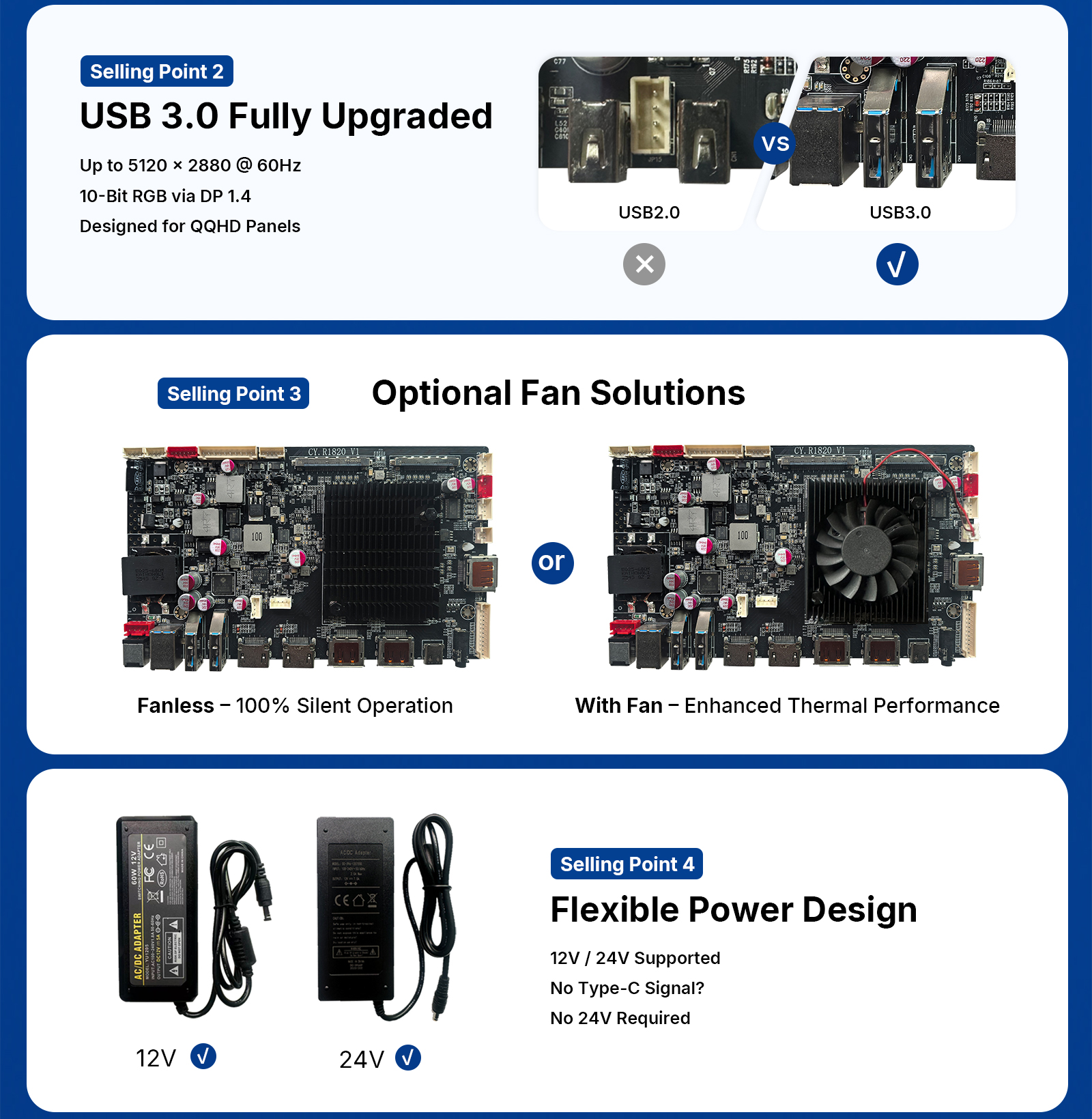
USB 3.0 supported
-
Upgraded USB architecture for:
-
Faster data transfer
-
Peripheral expansion
-
Improved system integration
-
Power Supply & Power Management
Supported power input configurations:
-
DC 12V + 5V input via 10-pin power connector
-
Single DC 24V input supported
Power design notes:
-
24V input is required only when USB-C PD charging is used
-
If USB-C signal is not used, the board can operate using 12V and 5V only
Power characteristics:
-
Normal working mode / low-power mode supported
-
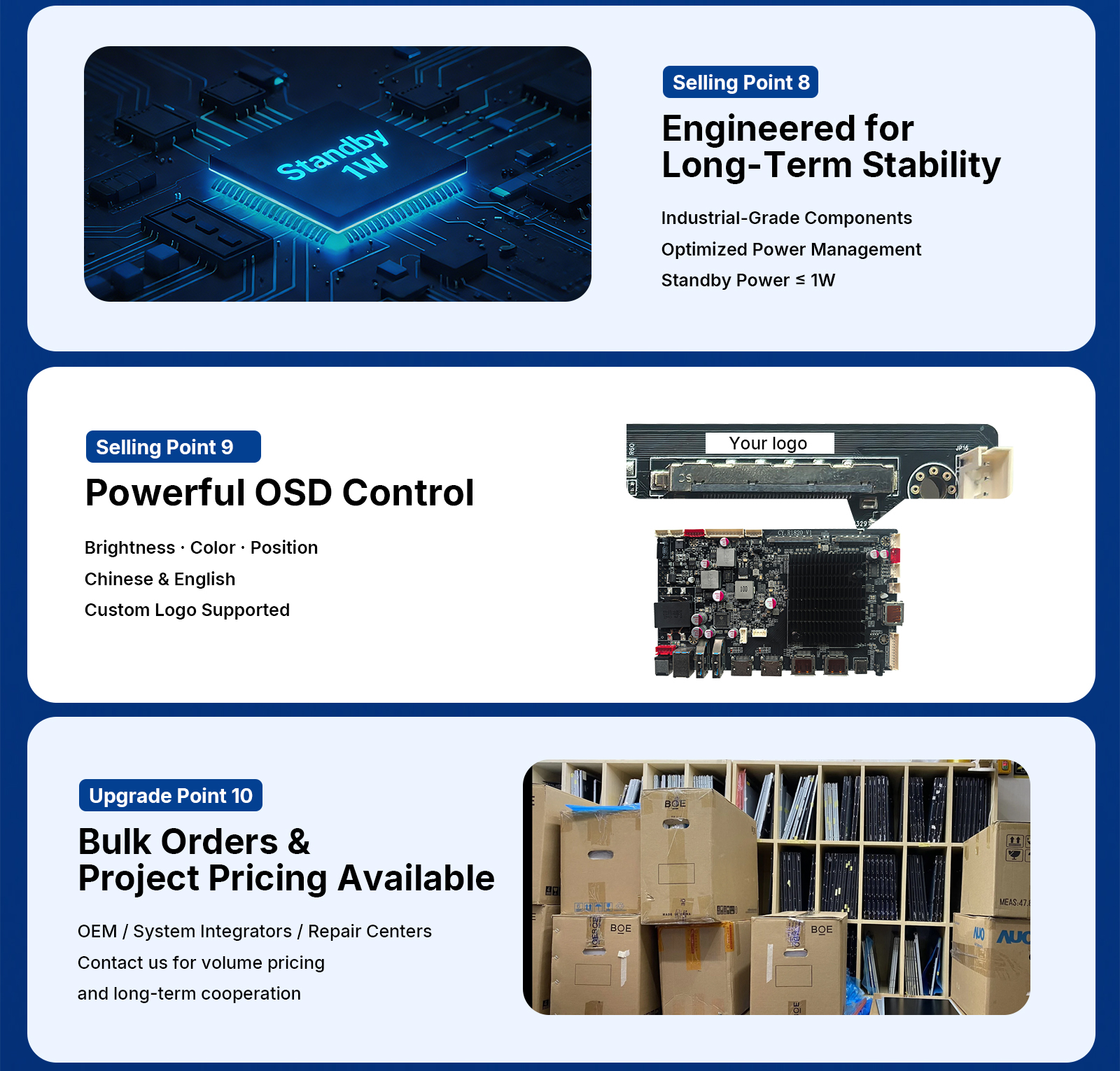
Standby power consumption: ≤ 1W
Thermal Design Options
R1820 is available in two thermal configurations:
-
Active cooling version (with fan)
-
Recommended for high-load or long-duration operation
-
-
Passive cooling version (fanless)
-
Completely silent
-
Suitable for noise-sensitive environments
-
Display Control & OSD Functions
-
5-key OSD control board
-
Optional IR remote control support
-
OSD functions include:
-
Brightness / contrast / saturation / hue
-
Color temperature (Warm / Cool / Standard / User)
-
Image position and scaling
-
Automatic image adjustment
-
OSD language support:
-
English
-
Simplified Chinese
-
Additional languages available via customization
Advanced Display Functions
-
Screen rotation:
-
90° / 180° / 270°
-
-
Multi-display modes:
-
PIP (Picture-in-Picture)
-
POP (Picture-out-Picture)
-
Quad-screen display
-
Mechanical & Environmental Specifications
-
PCB dimensions: 175.5 × 102.5 × 18 mm
-
Operating temperature: 0 ~ +40°C
-
Storage temperature: –10 ~ +60°C
-
Relative humidity: ≤ 80%
Designed for stable operation in professional and industrial environments.
Installation & Integration
-
Plug-and-play architecture
-
No soldering required
-
Compatible with original panel wiring
-
Clear connector definitions for:
-
Panel
-
Backlight
-
Power
-
OSD
-
Audio
-
Proper power sequencing and grounding are recommended to ensure stable operation.
Customization & Engineering Support
R1820 supports:
-
Custom boot logo
-
OSD language customization
-
Region-specific configuration
Suitable for OEM, system integration, and project-based applications.
Summary
R1820 V1.0 is a professional-grade 5K LCD control board designed for engineers who require:
-
High-resolution QQHD output
-
Modern HDMI 2.1 / DP 1.4 interfaces
-
USB-C with PD support
-
Flexible power architecture
-
Stable long-term operation
It is a robust platform for high-resolution display system development and iMac panel reuse projects.
Product Description – R1820 V1.0
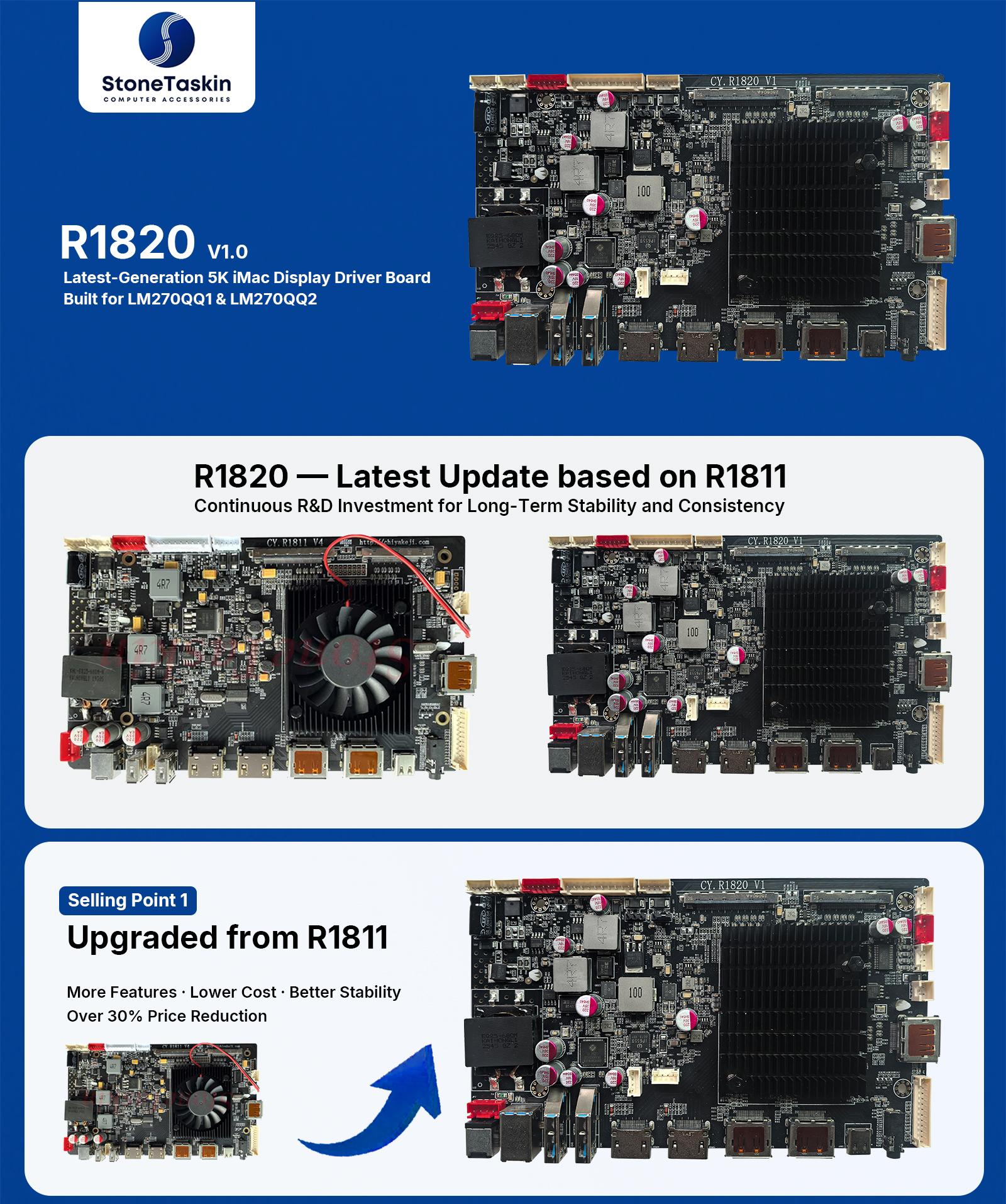
R1820 V1.0 is a newly developed 5K LCD driver board designed for iMac 27-inch displays LM270QQ1 and LM270QQ2 (all suffix versions).
Although R1820 is developed based on long-term experience with the R1811 series, it is not a replacement.
R1820 is built on a different technical solution, using a different main control architecture, and follows a separate engineering route.
R1811 and R1820 are designed to coexist, offering users different solutions based on their specific requirements, system preferences, and project scenarios.
Independent Solution, Different Architecture
R1820 adopts a new system architecture and a different main control chip compared to R1811.
This independent design allows R1820 to introduce:
-
HDMI 2.1 high-speed signal transmission
-
DisplayPort 1.4 support
-
Full USB 3.0 upgrade
-
More flexible power input options (12V / 24V)
-
Optional fan or fanless thermal design
Rather than reusing the R1811 platform, R1820 follows a new hardware and system design philosophy, optimized for updated interfaces, power flexibility, and modern usage scenarios.
Developed from Experience, Not Directly Upgraded
R1820 benefits from real-world feedback and long-term validation of R1811, but it is not a simple revision or modification.
It represents:
-
A different technical route
-
A new balance between performance, flexibility, and cost efficiency
-
A next-generation solution for users seeking updated connectivity and system design
This makes R1820 suitable for users who prefer a new-generation architecture, while R1811 remains available for users who require continuity with the previous solution.
Why R1811 and R1820 Are Both Available
We believe professional users should have choices, not forced upgrades.
-
R1811 remains a mature, field-proven solution with a well-established architecture.
-
R1820 is offered as an alternative solution with a different design approach and updated interfaces.
Both products are actively supported as part of our long-term product strategy.
Positioning Summary
-
R1811: Proven, mature solution based on an established platform
-
R1820: Newly designed solution with a different architecture and updated feature set
Choose the solution that best fits your application, not just the newest model number.